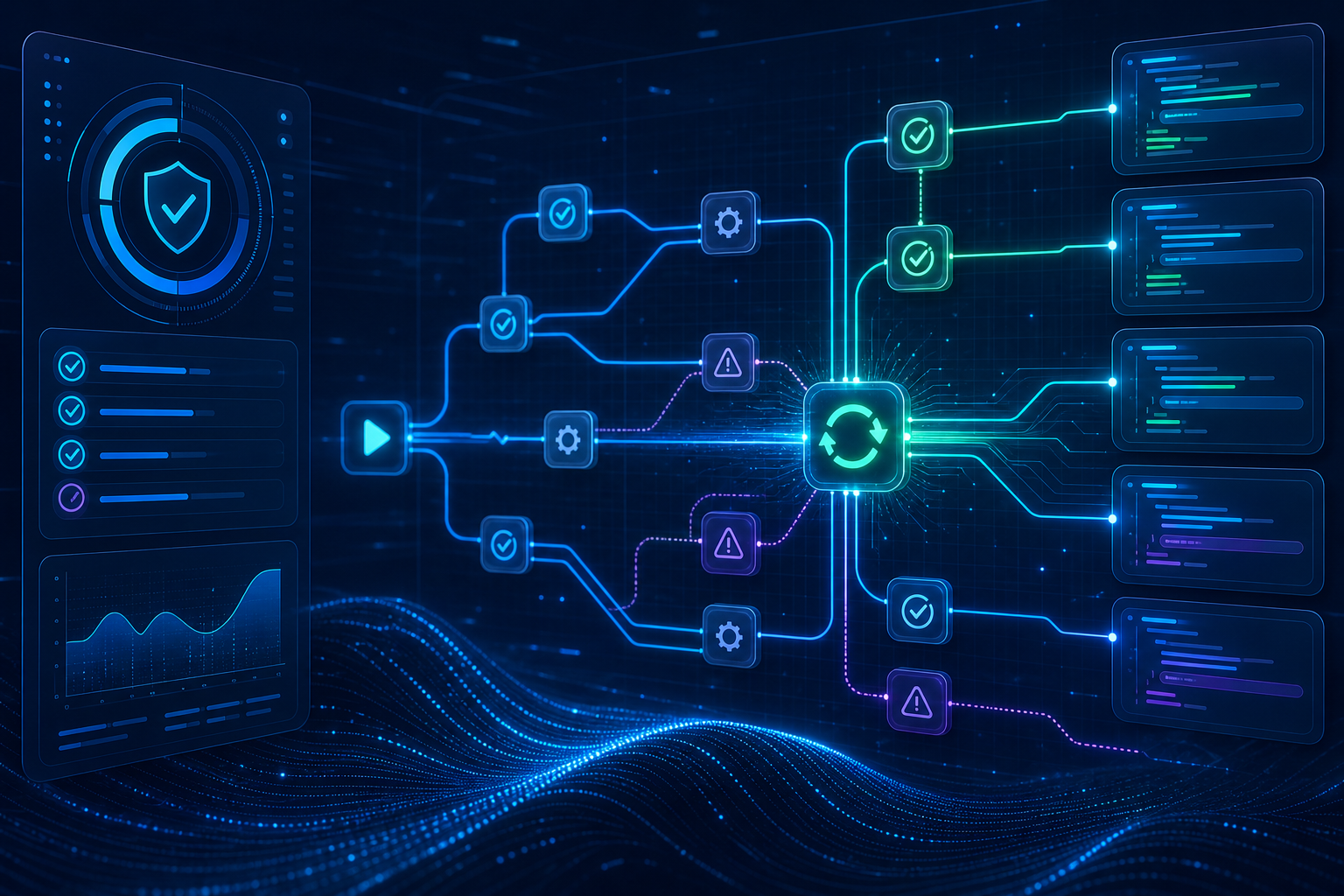
Discover how self-healing test automation uses machine learning to resolve broken locators dynamically, cut maintenance time, and stabilize CI/CD pipelines.
Self healing tests are automated scripts that use machine learning algorithms to detect and adapt to code changes in an application under test without human intervention. Instead of failing immediately when an element ID, class, or DOM path shifts, self healing test engines evaluate surrounding visual, structural, and semantic attributes to locate the intended element and continue execution. Incorporating AI into test execution significantly reduces maintenance overhead while maintaining rigorous validation standards.
- Self-healing locators dynamically evaluate weighted DOM trees to prevent false test failures.
- Using artificial intelligence reduces script maintenance overhead by up to 50 percent during rapid release cycles.
- Dynamic healing algorithms preserve test speed without hiding genuine application regressions.
- Implementation requires clear confidence scoring thresholds and transparent locator audit logs.
How Self Healing Tests Work Under the Hood
Self healing tests operate by capturing a multi-attribute snapshot of every UI component during initial test runs, rather than relying on a single static selector. When code changes alter an element, the engine evaluates surrounding node graphs, accessibility labels, neighbor hierarchies, and visual positions to resolve the target element accurately at runtime.
Traditional test frameworks fail the moment an engineer changes a CSS class or updates a dynamic ID generated by modern frontend frameworks. If your script looks strictly for button#submit-btn-revised, any upstream change in the frontend build pipeline breaks the build. This fragility forces quality assurance teams into endless reactive maintenance loops.
Modern test engines solve this by gathering a weighted matrix of element attributes. When an automation run starts, the system registers element coordinates, tag types, ARIA attributes, text contents, parent-child relationships, and visual bounding boxes. If the primary selector fails during execution, a fallback scoring algorithm assesses alternative candidate nodes. If a candidate matches with high statistical confidence—often set at 85% or higher—the runner uses that element and logs the locator drift.
Architecturally, this concept complements structured patterns like the Page Object Model. Rather than requiring engineers to manually refactor page classes after every frontend pull request, the framework handles minor DOM shifts in memory. When teams deploy AI agents for testing, these underlying models continuously learn which selector combinations remain stable across successive deployments.
Why AI for Functional Testing Outperforms Static Selectors
Applying ai for functional testing outperforms static selectors because it evaluates intent and semantic relationships rather than hardcoded DOM paths. By analyzing contextual cues and application behavior, intelligent engines distinguish between benign interface updates and true functional breakages, preserving pipeline velocity across iterative product releases.
Recent industry data suggests that QA engineers spend between 30% and 50% of their active sprint capacity updating fragile locators. In fast-moving development environments, frontends morph daily. Single-page applications built on React, Vue, or Angular frequently produce ephemeral class names and dynamic identifiers that render static XPath definitions obsolete within days.
Using ai for functional testing shifts verification from brittle string matching to intent-based interaction. For instance, if an e-commerce checkout button moves from the lower-right container to a sticky footer banner, an intelligent runner inspects the semantic role, the label text, and the surrounding form context to verify the element. This resilience allows automated suites to run continuously in parallel environments without unnecessary flakiness.
Consider how traditional automation tools compare against modern self-healing solutions across standard operational dimensions:
| Capability | Static Selectors | Self-Healing Engines | Operational Impact |
|---|---|---|---|
| Locator Drift Handling | Fails immediately | Resolves via weighted graph | Prevents pipeline blockage |
| Maintenance Burden | Requires manual script edits | Generates auto-remediation PRs | Cuts maintenance hours |
| Dynamic ID Support | Requires complex Regex | Evaluates semantic structure | Stabilizes agile deployments |
| Confidence Scoring | Binary pass or fail | Configurable threshold values | Prevents false positive clicks |
As illustrated, moving away from brittle matching fundamentally alters deployment cadences. Teams escape the trap of investigating red builds that stem purely from renamed class names rather than actual application bugs.
How Do Machine Learning Models Score Candidate Locators?
Machine learning models score candidate locators by calculating cosine similarity across DOM attribute vectors, visual geometry, and semantic hierarchy. The engine extracts candidate elements matching the general footprint of the missing node, assigns weighted scores across multiple vectors, and selects the candidate that surpasses a predefined statistical threshold.
Under the surface, the healing algorithm relies on a series of independent scoring heuristics. When a test driver cannot locate an element defined in the test script, the engine pauses DOM interaction for a few milliseconds and performs an extraction pass on the current document tree. It inspects several core dimensions:
- Hierarchical Proximity: Evaluates depth in the DOM tree, matching parent wrappers, sibling counts, and structural tags against historical baselines.
- Semantic and Accessibility Data: Compares
aria-label,role, input types, and associated labels defined in standard W3C WebDriver specifications. - Visual and Spatial Attributes: Measures coordinate distances, aspect ratios, color contrast, and relative positioning within the browser viewport.
- Textual Similarity: Utilizes string distance formulas like Levenshtein distance to evaluate changes in button labels, placeholders, or tooltips.
Each dimension receives a mathematical weight based on team configuration or historical stability. If a candidate button matches the text, parent form, and accessibility label with a combined score of 0.92, the engine interacts with the button, marks the test step as healed, and records the event in the test run telemetry.
Key Challenges and Failure Modes in Dynamic Healing
Dynamic test healing introduces operational risks when improperly monitored, most notably masking unintended visual defects and generating false positives. If the algorithm interacts with an unintended button because confidence thresholds are set too low, the automated suite may report a false pass while a genuine bug escapes into production.
Silent regressions represent the greatest hazard in automated remediation. Suppose a developer accidentally deletes a primary checkout action and leaves behind a secondary cancel button that shares several DOM attributes. An overly aggressive healing engine might snap to the cancel element, click it, observe a route change, and falsely validate the test flow.
To prevent this outcome, engineering leaders must enforce strict governance rules:
- Establish high confidence thresholds (minimum 80% to 90%) before an engine can execute an interaction automatically.
- Require detailed healing logs that show side-by-side screenshots and DOM diffs between the original element and the healed candidate.
- Integrate locator updates back into source control via automated pull requests, preventing divergence between codebase scripts and runtime heuristics.
- Regularly review suite reliability metrics against established frameworks for flaky test resolution.
Engineering teams that treat healing as an automated bridge rather than an excuse to abandon disciplined test design maintain the highest release confidence. As software delivery author Martin Fowler notes on test strategies, maintainable tests require explicit intent and tight feedback loops, regardless of the underlying tooling.
Implementing Self-Healing Automation in Modern CI/CD
Implementing self-healing test automation requires embedding intelligent test runners directly into continuous integration workflows, configuring locator telemetry export, and defining feedback mechanisms for engineering teams. Teams should start by retrofitting high-maintenance regression suites before expanding coverage across edge-case scenarios.
Begin by profiling your existing test repository. Identify the 10% to 20% of test cases that generate the highest volume of false alarms due to frontend changes. Typically, user onboarding flows, dynamic dashboard pages, and complex form submissions account for the bulk of flaky failures.
Next, integrate an engine capable of dynamic fallback analysis into your test runner. Configure the runner to run in observation mode for the first 50 builds. During observation mode, the runner flags when an element would have failed and records what candidate it would have chosen, without overriding the execution. This calibration period allows QA architects to verify that the scoring weights align with the team's application architecture.
Finally, connect the engine to your notification channels. When self healing tests trigger in the pipeline, the system should generate a concise alert containing the old selector, the suggested selector, and a direct link to the test execution video. By treating dynamic healing as an intelligent assistant that writes locator patches for developers, teams maintain pristine test suites without sacrificing delivery cadence.
Frequently Asked Questions
What are self healing tests in test automation?
Self healing tests are automated scripts that use machine learning to detect when UI locators change. Instead of throwing an element not found exception, the runner analyzes surrounding DOM attributes, visual location, and semantic properties to find the intended element dynamically, allowing test execution to complete without manual maintenance.
How does ai for functional testing improve QA efficiency?
Applying ai for functional testing improves QA efficiency by automating the triage and maintenance of fragile test scripts. It distinguishes between benign interface design adjustments and genuine code defects, reducing false-positive build failures and cutting manual locator maintenance by up to 50 percent during rapid release cycles.
Can self healing tests conceal actual application bugs?
Yes, if confidence thresholds are set too low, a self-healing algorithm might interact with the wrong element and mask an application bug. To avoid this, teams should mandate confidence thresholds above 85 percent, maintain detailed visual and DOM audit trails, and require human review of all healed locator updates before merging them into code.

Priya Sharma
Senior QA Architect with 12+ years in test automation. Passionate about AI-driven testing and building resilient test frameworks.