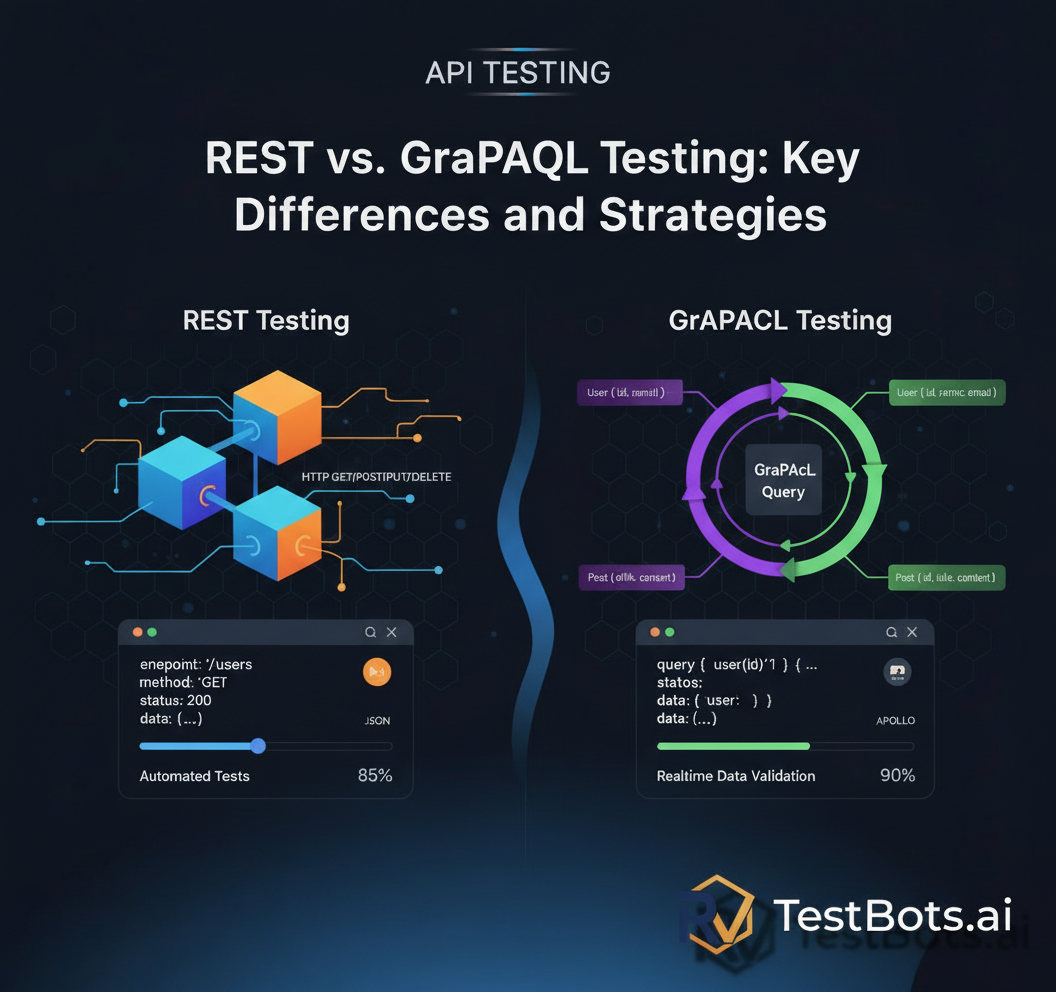
Understanding the nuances of REST vs. GraphQL testing is crucial for modern software quality assurance. This post delves into the core differences and outlines concrete strategies to efficiently test both API architectures, ensuring robust and reliable applications.
In the dynamic landscape of software development, API architectures like REST and GraphQL continue to evolve, each presenting unique challenges and opportunities for quality assurance. For software quality assurance professionals and QA management, mastering the intricacies of REST vs. GraphQL testing is no longer optional—it's a critical skill for delivering high-quality applications and beyond. As organizations increasingly adopt microservices and distributed systems, the API layer becomes the backbone of their digital offerings, making comprehensive and efficient API testing paramount.
The global API management market is projected to reach over $11.6 billion highlighting the pervasive reliance on APIs across industries. This growth underscores the need for robust testing methodologies that can keep pace with rapid development cycles and complex data interactions. While both REST and GraphQL serve as interfaces for client-server communication, their fundamental design philosophies lead to distinct testing approaches. Ignoring these differences can result in inefficient test suites, missed defects, and ultimately, a compromised user experience.
Understanding REST and GraphQL: A Brief Overview
Before diving into testing strategies, let's briefly recap the core tenets of REST and GraphQL to better appreciate their testing implications.
REST (Representational State Transfer)
REST is an architectural style that leverages standard HTTP methods (GET, POST, PUT, DELETE) to interact with resources identified by unique URIs. It's stateless, meaning each request from a client to a server contains all the information needed to understand the request. REST APIs are typically resource-centric, with predefined endpoints returning fixed data structures.
- Statelessness: Each request is independent.
- Resource-Oriented: Data is organized into distinct resources.
- Standard HTTP Methods: Utilizes GET, POST, PUT, DELETE for CRUD operations.
- Multiple Endpoints: Different data types often reside at different URLs.
GraphQL
Developed by Facebook, GraphQL is a query language for APIs and a runtime for fulfilling those queries with your existing data. Unlike REST, GraphQL exposes a single endpoint, and clients send queries specifying exactly what data they need. This allows for fetching multiple resources in a single request, reducing over-fetching and under-fetching of data.
- Single Endpoint: All interactions happen through one URL.
- Client-Driven Data Fetching: Clients specify the exact data structure they require.
- Strongly Typed Schema: Defines the data available and its relationships.
- Queries and Mutations: Queries for reading data, Mutations for writing/modifying data.
Key Differences Impacting REST vs. GraphQL Testing
The architectural disparities between REST and GraphQL directly influence how we approach their testing. Understanding these differences is the foundation for effective test strategy development.
Endpoint Structure and Data Fetching
- REST: Testing involves validating multiple endpoints, each with a predefined response structure. Testers must ensure that each endpoint returns the correct data for its specific resource and that HTTP status codes are handled appropriately. This often leads to a higher number of individual test cases covering various endpoint paths.
- GraphQL: With a single endpoint, testing shifts from endpoint-centric validation to query-centric validation. Testers need to verify that the API correctly processes complex queries, handles nested data requests, and returns only the requested fields. This means fewer 'endpoint' tests, but more complex 'query' tests that can combine many data types.
Schema vs. Resource Definition
- REST: While REST has no formal schema language, OpenAPI (Swagger) specifications are commonly used to describe API endpoints, request/response structures, and parameters. Testing often involves validating that the API implementation adheres to these specifications.
- GraphQL: GraphQL is inherently strongly typed, defined by a schema. This schema acts as a contract between client and server. Testing largely revolves around ensuring the API's behavior aligns with its schema, including type validations, field resolvers, and argument handling. Tools can leverage this schema for automated test generation and validation.
Error Handling and Status Codes
- REST: Leverages standard HTTP status codes (200 OK, 404 Not Found, 500 Internal Server Error, etc.) to indicate success or failure. Error messages are typically returned in the response body. Testing ensures correct status codes are returned for various scenarios.
- GraphQL: Often returns a 200 OK status code even when an error occurs within the query processing. Errors are typically nested within an 'errors' array in the JSON response body, alongside any partial data. Testers must parse the response body to detect and validate errors, rather than solely relying on HTTP status codes.
Security Considerations
Security testing is paramount for both, but the attack surfaces differ.
- REST: Focuses on securing individual endpoints, often through methods like OAuth or JWT. Common vulnerabilities include broken access control, injection flaws, and insecure configurations. (Refer to OWASP API Security Top 10 for more details.)
- GraphQL: Faces unique threats like excessive data exposure (due to flexible queries), denial-of-service attacks (through deep or complex queries), and insecure direct object references by manipulating query arguments. Thorough authorization and authentication testing, along with query depth/complexity limiting, are critical.
Effective Testing Strategies for REST APIs
Testing REST APIs demands a structured approach that covers functional, performance, and security aspects effectively.
1. Comprehensive Endpoint Validation
For each endpoint, create test cases that cover:
- Positive Scenarios: Valid requests returning expected data and 2xx status codes.
- Negative Scenarios: Invalid inputs, missing parameters, incorrect authentication, and boundary conditions. Verify appropriate 4xx and 5xx status codes and meaningful error messages.
- Data Validation: Ensure response data types, formats, and values conform to expectations (e.g., JSON schema validation).
- CRUD Operations: Test the full lifecycle of resources (Create, Read, Update, Delete).
2. Performance and Load Testing
REST APIs are often critical for application responsiveness. Use tools to simulate high loads and measure:
- Response Times: Under various load conditions.
- Throughput: Number of requests processed per second.
- Error Rates: Identify bottlenecks and potential failures.
3. Security Testing for REST
Beyond functional correctness, ensure your APIs are secure:
- Authentication & Authorization: Verify only authorized users/systems can access specific resources.
- Input Validation: Prevent SQL injection, XSS, and other injection attacks.
- Rate Limiting: Test protection against brute-force attacks.
- Data Encryption: Ensure sensitive data is encrypted in transit and at rest.
"The true measure of an API's quality lies not just in its functionality, but in its resilience under stress and its imperviousness to attack." - Ministry of Testing
Effective Testing Strategies for GraphQL APIs
GraphQL's unique architecture necessitates a shift in testing mindset. Here's how to approach it:
1. Schema-Driven Testing
Leverage the GraphQL schema as your primary source of truth:
- Schema Validation: Ensure the deployed API's schema matches the expected schema.
- Type System Verification: Test that all fields adhere to their defined types (e.g., a field declared as an 'Int' truly returns an integer).
- Directive Testing: If using custom directives, test their behavior and impact on queries.
2. Query and Mutation Testing
Focus on the flexibility of GraphQL:
- Basic Queries: Test simple data fetching for each type.
- Complex Nested Queries: Verify that deeply nested relationships are resolved correctly and efficiently.
- Fragment Testing: Ensure fragments are correctly applied and return the expected subset of data.
- Argument Validation: Test valid and invalid arguments for fields and mutations, including nullability.
- Mutations: Thoroughly test all mutation operations (create, update, delete). Verify the state changes and the returned payload.
- Error Handling: Explicitly test scenarios where errors are expected within the 'errors' array of the response.
3. Performance of GraphQL Queries
The flexibility of GraphQL can lead to N+1 query problems. Performance testing should:
- Test Complex Queries: Measure the response time and resource consumption of highly nested or extensive queries.
- Batching and Caching: Verify that batching and caching mechanisms are working as expected to optimize performance.
- Throttling/Rate Limiting: Test the API's ability to handle excessive query requests to prevent abuse.
4. Security Testing for GraphQL
Specific GraphQL vulnerabilities require focused attention:
- Query Depth/Complexity Limiting: Test that the server correctly rejects overly complex or deep queries to prevent DoS attacks.
- Authorization for Fields: Verify that users can only access fields they are permitted to see, even if they explicitly request them.
- Introspection Disabling (in production): Check that introspection is disabled to prevent attackers from easily mapping your API schema.
- Data Exposure: Test for scenarios where over-fetching might inadvertently expose sensitive data.
Tools and Automation for Both Architectures
Regardless of the API architecture, automation is key to efficient and scalable testing:
- API Testing Frameworks: Postman, Insomnia, Apollo GraphQL Client, Cypress (for end-to-end with API calls) are popular choices. For robust automation, consider libraries like Rest-Assured (Java) or Supertest (Node.js).
- Contract Testing: Tools like Pact or Spring Cloud Contract help ensure that client and server API contracts remain compatible, preventing integration issues. This is especially valuable in microservices architectures.
- Schema Validation Tools: For GraphQL, tools can automatically generate tests from the schema or validate queries against it.
- Test Data Management: Generating realistic and varied test data is crucial. TestBots.ai's Test Data Generator can streamline this process.
- CI/CD Integration: Integrate API tests into your continuous integration/continuous deployment pipeline to catch regressions early.
For comprehensive API testing, especially in complex environments, platforms like TestBots.ai provide invaluable assistance. Our AI Test Studio can help automate the creation and maintenance of API tests for both REST and GraphQL, leveraging AI to understand API contracts and generate intelligent test cases. This significantly reduces the manual effort involved in setting up and running extensive API test suites.
Looking Ahead: Best Practices and Beyond
As API architectures continue to evolve, so too must our testing practices. Here are some best practices for QA professionals:
- Shift-Left Testing: Involve QA earlier in the development cycle. Reviewing API designs and schemas before implementation can prevent costly rework.
- API-First Development: Adopt an API-first approach where APIs are designed and documented before UI development begins. This facilitates parallel development and robust API testing.
- Mocking and Virtualization: Use API mocking to test client-side applications independently of backend development, or to simulate complex error conditions.
- Observability: Integrate API testing with monitoring tools to gain insights into API performance and behavior in production.
- Continuous Learning: Stay updated with the latest API trends, security vulnerabilities, and testing tools. Resources like Google's Testing Blog and Martin Fowler's articles on testing are excellent starting points.
Conclusion
The choice between REST and GraphQL often depends on specific project requirements, but regardless of the architecture, thorough API testing is non-negotiable for delivering high-quality software. Understanding the core differences between REST vs. GraphQL testing allows QA teams to tailor their strategies, optimize their test suites, and ultimately, ensure reliable and secure API interactions.
As a software quality assurance tester or manager, your ability to adapt and implement effective testing strategies for diverse API architectures will be a key differentiator. Leveraging advanced platforms like TestBots.ai, with its AI-powered capabilities and extensive suite of free tools, can significantly enhance your API testing efforts, from generating test data to recording complex test scripts. Explore how TestBots.ai's Test Script Recorder and other features can empower your team to achieve unparalleled API quality.

James Park
API testing guru and technical writer. Experienced with REST, GraphQL, and microservices testing patterns.