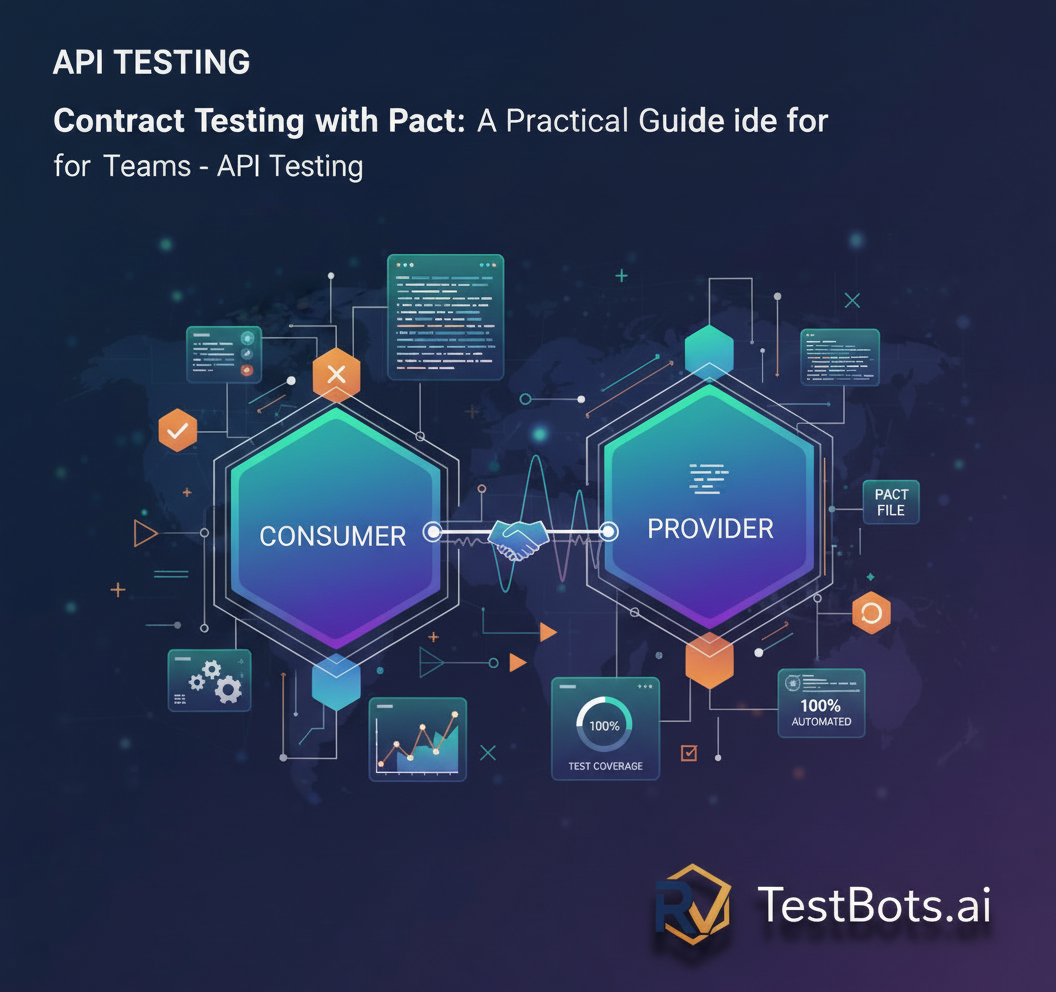
Integration failures often plague modern microservices architectures. Contract testing with Pact offers a robust solution, ensuring harmonious API interactions. This guide delves into practical implementation strategies for QA teams.
Contract Testing with Pact: A Practical Guide for Teams
In the rapidly evolving landscape of software development, microservices have become the de facto architecture for building scalable and resilient applications. However, this distributed nature introduces a significant challenge: ensuring seamless integration between numerous independent services. Without robust testing, what appears to be a minor change in one service can cascade into catastrophic failures across the entire system. This is where contract testing with Pact emerges as a critical strategy, offering a precise and efficient way to validate API interactions and prevent costly integration bugs.
the reliance on well-defined API contracts is more pronounced than ever. Organizations are pushing for faster release cycles, and traditional end-to-end testing, while valuable, often becomes a bottleneck due to its complexity and execution time. Contract testing fills this gap by shifting left, allowing teams to verify integrations earlier in the development lifecycle. For software quality assurance professionals and QA management, adopting contract testing isn't just an improvement; it's a strategic imperative for maintaining high-quality software delivery.
The Integration Predicament: Why Traditional Testing Falls Short
Consider a typical microservices ecosystem where Service A (the consumer) relies on Service B (the provider) for specific data. Historically, verifying this interaction involved either:
- End-to-End (E2E) Testing: Deploying both services and running tests against the integrated system. This is often slow, flaky, and difficult to pinpoint the exact source of failure when something breaks.
- Mocking/Stubbing Providers: Consumers create their own mocks of the provider service. While faster, this approach is prone to 'mock drift' – the mocks might not accurately reflect the actual provider's behavior, leading to false positives or missed integration bugs in production.
Both methods have their drawbacks. E2E tests are resource-intensive and often run late in the cycle, making defects expensive to fix. Mocks, on the other hand, can create a false sense of security. The true pain point is often the lack of a shared understanding and enforcement of the API contract between consumer and provider teams. This is where contract testing with Pact shines, ensuring that both sides adhere to an agreed-upon interface without requiring them to be deployed together.
"the global market for software testing services is projected to reach over $50 billion, with a significant driver being the increased adoption of microservices and the need for sophisticated integration testing strategies like contract testing." - ZDNet
What is Contract Testing and How Does Pact Help?
Contract testing is a technique for testing an integration point between two separate applications by checking that each application upholds its side of the 'contract' (the API agreement). It focuses on the messages exchanged between a consumer (the client making the request) and a provider (the service responding to the request).
Pact is a consumer-driven contract testing framework. This means the consumer team defines the expectations they have of the provider's API. Here's how it works at a high level:
- Consumer Defines Expectations: The consumer team writes a test that defines the HTTP requests it will make to the provider and the expected HTTP responses.
- Pact Generates a Contract: From these consumer tests, Pact generates a 'pact file' – a JSON representation of the contract.
- Pact Broker: This pact file is published to a central repository called a Pact Broker.
- Provider Verifies Contract: The provider team then retrieves this pact file from the broker and verifies that their actual API implementation satisfies the expectations defined in the contract.
- Faster Feedback Loops: Integration issues are detected during unit or component testing, significantly reducing the time and cost of defect resolution.
- Reduced End-to-End Test Burden: While E2E tests are still necessary for business flow validation, contract testing reduces their critical path, allowing them to focus on higher-level scenarios.
- Improved Team Collaboration: Pact acts as a concrete communication tool, fostering a shared understanding of API contracts between consumer and provider teams.
- Independent Deployments: Enables teams to deploy services independently with confidence, knowing that API compatibility is maintained.
- Increased Confidence in Releases: Drastically lowers the risk of unforeseen integration failures reaching production.
- Add Pact Dependency: Integrate the Pact testing library for their chosen language (e.g., Pact-JVM for Java, Pact-JS for JavaScript, Pact-Go for Go).
- Write Consumer Tests: These are essentially unit tests for the consumer's client code that interacts with the provider. Instead of calling the real provider, they interact with a mock service provided by Pact.
- Publish Pact File: After the consumer tests pass, a pact file (e.g.,
frontendapp-productservice.json) is generated. This file needs to be published to a Pact Broker, which acts as a central hub for all contracts. This is typically done as part of the consumer's CI/CD pipeline. - Add Pact Dependency: Similar to the consumer, but for provider verification.
- Retrieve Pact Files: The provider pulls relevant pact files from the Pact Broker. The broker can intelligently determine which pacts need to be verified based on service versions.
- Run Provider Verification: The provider's test suite uses the Pact library to replay the requests from the pact file against their actual running service (often in a test environment or embedded within the test suite). Pact will then assert that the actual responses from the provider match the expected responses defined in the contract.
- Publish Verification Results: The results of the provider verification are published back to the Pact Broker.
- CI/CD Integration: Automate the generation, publishing, and verification of pacts within your continuous integration pipelines. Tools like Jenkins, GitLab CI, GitHub Actions, and Azure DevOps Integration can be configured to run Pact tests and leverage the Pact Broker's "Can I Deploy?" functionality.
- API Testing Tools: While Pact handles contract enforcement, traditional API testing tools (e.g., Postman, SoapUI) are still useful for exploratory testing, performance testing, and validating non-functional requirements of APIs.
- Test Automation Platforms: Platforms like TestBots.ai can orchestrate these diverse testing efforts. Our AI Test Studio and Test Script Recorder can help you build and manage other layers of your test automation, freeing your team to focus on the critical contract definitions.
- Observability: Combine contract test results with observability tools (monitoring, logging, tracing) in production to get a complete picture of API health.
- Initial Learning Curve: Pact has its own DSL and concepts. Provide training and pair programming sessions for your teams. The Ministry of Testing and Test Guild offer excellent resources.
- Managing Provider States: Providers need to set up specific data conditions (states) for each interaction defined in the pact file. This can be complex. Invest in robust test data management strategies and clear documentation.
- Versioning: Properly versioning your pacts and services is crucial. The Pact Broker helps with this, but teams need to establish clear versioning policies.
- Non-HTTP Interactions: Pact is primarily designed for HTTP/REST APIs. For other protocols (e.g., message queues), consider extensions or alternative contract testing tools.
This process ensures that both teams are working off the same API contract, preventing breaking changes from being deployed. It's a proactive approach to quality, catching integration issues before they even reach a shared environment.
Key Benefits of Adopting Pact for Contract Testing
A Practical Guide to Implementing Pact in Your Team
Implementing contract testing with Pact requires a cultural shift and a structured approach. Here's a step-by-step guide for teams looking to integrate Pact into their development and QA workflows:
Step 1: Identify Your First Consumer-Provider Pair
Don't try to roll out Pact across your entire microservices architecture at once. Start small. Choose a critical, well-understood consumer-provider interaction. This allows your team to learn the ropes without overwhelming complexity. Look for a pair where integration issues have historically been problematic or where changes are frequent.
Step 2: Consumer-Side Setup and Contract Generation
The consumer team takes the lead here. They will:
Example (simplified JavaScript/Jest):
const { PactV3, MatchersV3 } = require('@pact-foundation/pact');
const { getProduct } = require('./productClient');

const provider = new PactV3({ consumer: 'FrontendApp', provider: 'ProductService' });

describe('ProductService API', () => {
  beforeAll(() => provider.setup());
  afterEach(() => provider.verify());
  afterAll(() => provider.finalize());

  it('gets a product by ID', async () => {
    const expectedBody = {
      id: MatchersV3.uuid(),
      name: 'Example Product',
      price: MatchersV3.decimal(10.99)
    };

    provider
      .given('product with ID 123 exists')
      .uponReceiving('a request for product 123')
      .withRequest({
        method: 'GET',
        path: '/products/123',
        headers: { 'Accept': 'application/json' },
      })
      .willRespondWith({
        status: 200,
        headers: { 'Content-Type': 'application/json' },
        body: expectedBody,
      });

    await provider.executeTest(async mockService => {
      const product = await getProduct(mockService.url, '123');
      expect(product).toEqual(expectedBody);
    });
  });
});
Step 3: Provider-Side Setup and Contract Verification
The provider team then:
Example (simplified Java/JUnit with Pact-JVM):
@Provider("ProductService")
@PactBroker(url = "https://your-pact-broker.com")
public class ProductServicePactTest {

    @BeforeEach
    void beforeEach(PactVerificationContext context) {
        context.setTarget(new HttpTestTarget("localhost", 8080)); // Your provider service runs on 8080
    }

    @TestTemplate
    @ExtendWith(PactVerificationInvocationContextProvider.class)
    void pactVerificationTestTemplate(PactVerificationContext context) {
        context.verifyInteraction();
    }

    @State("product with ID 123 exists")
    public void product123Exists() {
        // Set up your provider's state, e.g., insert data into a test database
        // so that your service can return the expected product for ID 123.
    }
}
Step 4: Leverage the Pact Broker for 'Can I Deploy?'
The Pact Broker is more than just a storage facility; it's a powerful tool for understanding service compatibility. The "Can I Deploy?" feature of the Pact Broker allows you to check if a consumer's version can safely interact with a provider's version based on the latest successful contract verifications. This is invaluable for CI/CD pipelines, providing confidence before deployment.
For QA consultants and managers, integrating this check into your release gates is paramount. Imagine preventing a deployment simply because a new version of a consumer is incompatible with the currently deployed provider – that's the power of Pact.
Integrating Pact with Your QA Strategy and Tools
Contract testing with Pact is not a replacement for other forms of testing, but rather an essential layer in a comprehensive testing pyramid. It complements unit tests, component tests, and a reduced set of critical end-to-end tests.
Common Challenges and Solutions
The Future of API Reliability with Contract Testing
As microservices architectures continue to dominate, the importance of robust integration testing will only grow. Contract testing with Pact offers a powerful, scalable, and developer-friendly solution to a pervasive problem. By shifting left and empowering teams to define and enforce API contracts, organizations can achieve faster release cycles, reduce technical debt, and deliver more reliable software.
For QA professionals, embracing contract testing means moving beyond reactive bug-finding to proactive quality assurance. It transforms the QA role into a strategic enabler of independent service development and deployment, making you an invaluable asset to any modern engineering team. The investment in tools and training for contract testing today will pay dividends in engineering efficiency and product stability well and beyond.
Ready to streamline your API testing and ensure flawless integrations? Explore the capabilities at TestBots.ai. Our platform offers a suite of tools designed to support modern QA practices, from AI-powered test generation to comprehensive test management. Check out our free tools to get started and see how we can help your team achieve unparalleled software quality.

James Park
API testing guru and technical writer. Experienced with REST, GraphQL, and microservices testing patterns.