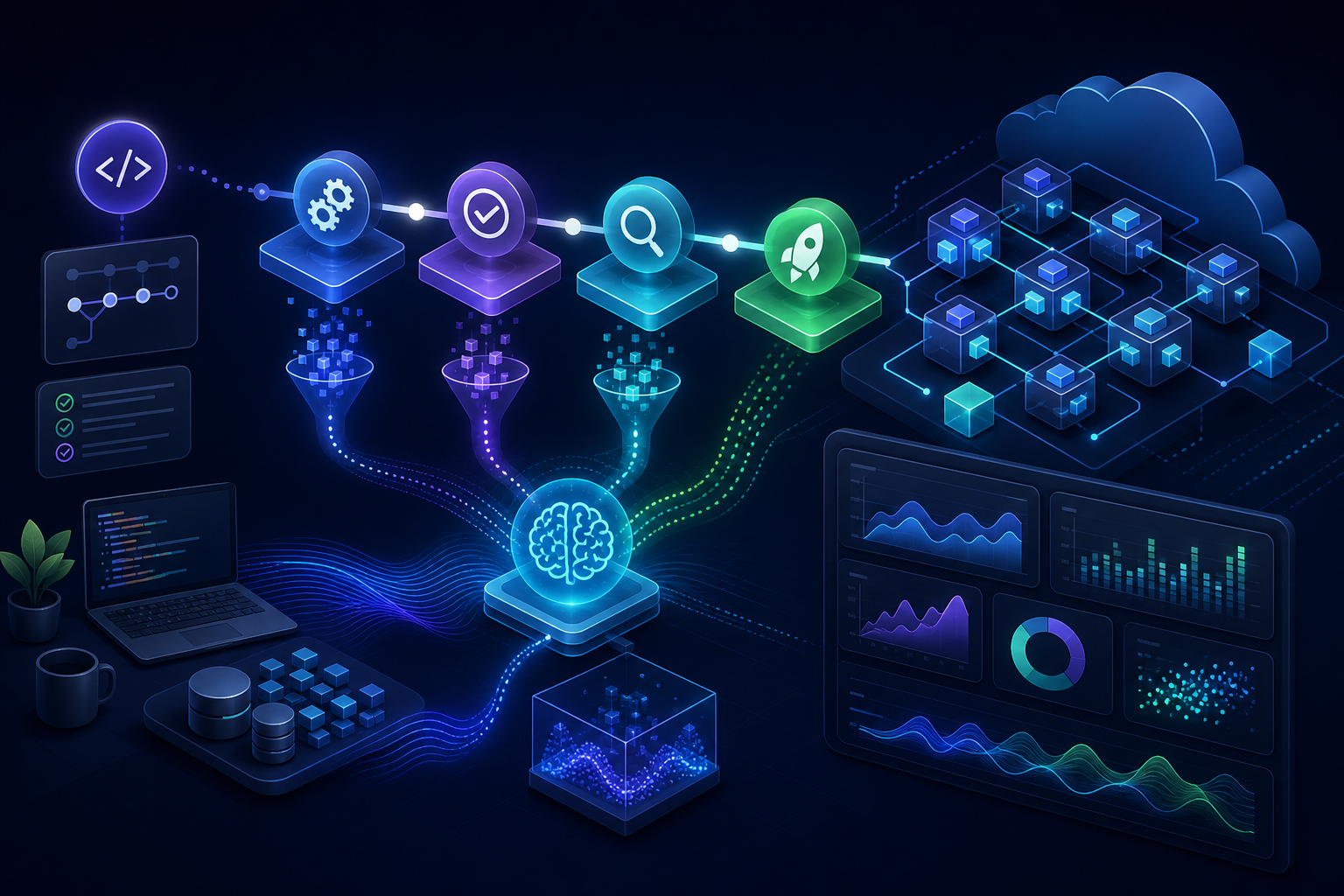
Modern engineering teams use AI driven QA to accelerate CI/CD integration testing, eliminating flaky builds, predicting pipeline failures, and cutting cycle times.
Implementing ai driven qa within continuous delivery pipelines fundamentally shifts how modern engineering teams validate distributed software. By deploying predictive test selection, dynamic mock generation, and autonomous root-cause analysis, machine learning models execute rigorous ci/cd integration testing without ballooning pipeline runtimes or generating false positives that stall deployments.
- Predictive test orchestration selects only relevant integration checks, reducing build times by up to 65%.
- Self-healing mock frameworks eliminate network flakiness across distributed microservice contracts.
- Real-time telemetry analysis surfaces breaking contract failures before pull requests merge into main branches.
- Machine learning models convert multi-repo integration suites from rigid blockers into proactive quality gates.
How Does AI Driven QA Improve Pipeline Efficiency?
Recent industry data suggests that engineering teams spend nearly 20% of their continuous deployment cycles triaging false test failures. Implementing ai driven qa resolves this bottleneck by dynamically prioritizing test suites based on changed files, historical commit failure patterns, and architectural dependencies across microservices rather than running static regression suites.
Conventional testing suites run hundreds of end-to-end integration scripts on every single pull request. This approach creates compute bottlenecks and extends developer feedback loops. When you inject intelligence into the execution phase, the test engine inspects the incoming code delta, maps impacted boundaries, and executes a targeted subset of integration checks.
For teams looking to optimize delivery workflows, adopting an AI-driven QA platform enables automated test selection that shortens cycle times while maintaining full boundary coverage across underlying services.
The Core Mechanics of CI/CD Integration Testing with AI
Based on current best practices, automated integration testing inside deployment pipelines relies on dynamic dependency evaluation and predictive failure modeling. Instead of relying on brittle wiremocks and static seed data, intelligent test runners synthesize realistic payloads and monitor distributed state transitions in real time.
Executing dependable ci/cd integration testing requires coordination across multiple distinct architectural layers:
- Smart Test Impact Analysis: Algorithms analyze Git diffs, AST parse trees, and runtime trace graphs to determine which downstream service contracts need verification.
- Dynamic Synthetic Mocking: Generative models simulate third-party API behaviors and edge cases, preventing pipeline failures caused by flaky third-party sandboxes.
- Automated Trace Triage: When a distributed transaction fails, natural language analysis correlates OpenTelemetry logs to pinpoint whether the root issue is an infrastructure timeout, database migration bug, or API schema mismatch.
Modern platforms like Kubernetes orchestrate temporary preview environments for these runs. However, managing transient resources demands precise control over execution duration to control cloud infrastructure bills.
Evaluating Traditional vs. AI-Driven Testing Strategies
Modern deployment environments require a balance between comprehensive test coverage and rapid delivery cycles. The following comparison highlights structural differences between conventional scripted verification and machine-learning-assisted approaches inside deployment pipelines.
| Capability | Traditional CI Testing | AI-Driven Approach | Operational Benefit |
|---|---|---|---|
| Test Selection | Static execution matrix | Predictive impact analysis | 65% faster feedback loops |
| Failure Triage | Manual log parsing | Automated trace clustering | Cuts triage time to minutes |
| Environment Flakiness | Retries and ignores | Self-healing mock synthesis | Eliminates non-code failures |
| Test Data Handling | Static seed snapshots | Dynamic schema generation | Prevents test pollution bugs |
To eliminate pipeline noise, many organizations combine intelligent selection with targeted tooling, as detailed in our guide on how to eliminate flaky tests in continuous delivery environments.
Which Architecture Best Supports Intelligent Integration Testing?
Based on current architectural patterns, a modular microservices topology backed by distributed telemetry provides the ideal foundation for intelligent verification. Automated pipelines require structured signals—such as distributed traces and uniform API specifications—to train and guide test orchestration engines effectively.
To implement intelligent ci/cd integration testing, teams should structure their delivery pipelines around three distinct verification stages:
- Ephemeral Service Instantiation: Ephemeral namespaces spin up only the modified service and immediate adjacent dependencies, while non-critical downstream dependencies are handled by intelligent mock agents.
- Targeted Contract Execution: Test runners execute focused contract tests against OpenAPI or GraphQL schemas, verifying backwards compatibility without requiring a complete staging cluster.
- Autonomous Triage Gates: The pipeline parses error signatures against historical cluster anomalies using tools documented by the Cloud Native Computing Foundation to distinguish between genuine regressions and transient network blips.
By coupling this architecture with predictive execution, engineering teams running ai driven qa strategies consistently reduce pull-request verification cycles from 45 minutes down to under 12 minutes, accelerating deployment frequency across all development squads.
Frequently Asked Questions
How does AI driven QA prevent integration test flakiness?
Intelligent QA platforms monitor historical run metrics, network latency patterns, and environment variability. By decoupling external third-party dependencies using dynamically synthesized mocks and adjusting dynamic wait parameters on the fly, intelligent runners isolate actual software logic failures from environmental hiccups.
Can intelligent integration testing replace end-to-end testing entirely?
Intelligent integration testing drastically reduces the need for heavy, end-to-end regression runs, but it does not replace them entirely. Instead, it catches boundary regressions, schema mismatches, and contract failures earlier in the pull-request phase, leaving only critical user journeys for asynchronous post-merge verification.
What telemetry data is required to train predictive test models?
Predictive engines require Git commit histories, changed code paths, historical build results, and runtime call graphs. By correlating code changes with previous pipeline test failures, the system accurately predicts which tests have the highest probability of catching introduced regressions.

Priya Sharma
Senior QA Architect with 12+ years in test automation. Passionate about AI-driven testing and building resilient test frameworks.